
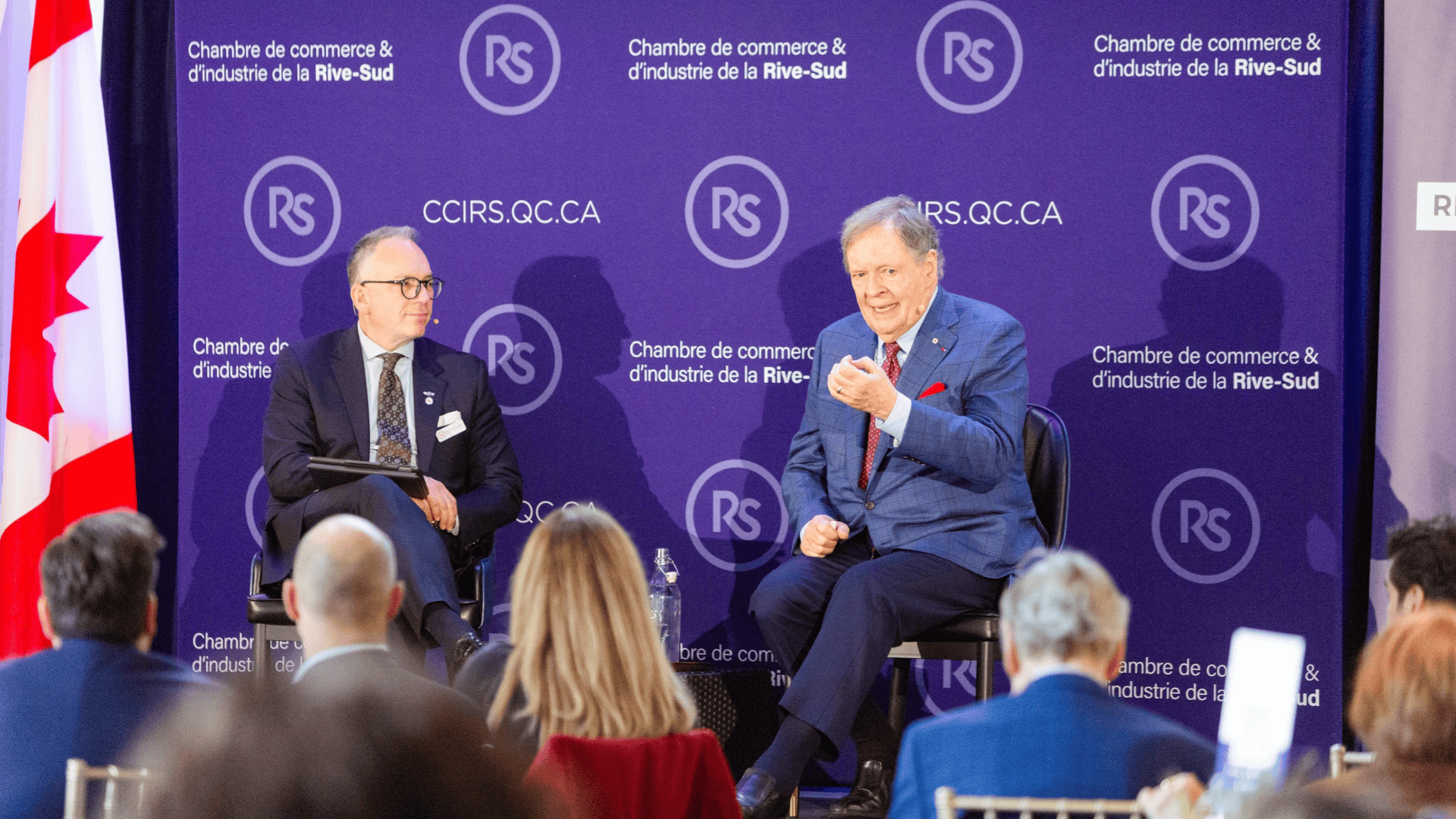
Brossard, October 26, 2026 – The economic relationship between Canada and the United States is undergoing a profound and lasting transformation, marked by the rise of protectionism, an erosion of trust between partners, and a realignment of the international balance of power. This was the message shared by Raymond Chrétien, former Canadian ambassador to the United States, during a « Grande Rencontre de la Rive-Sud » event held on October 22. For Canadian companies, this new reality requires them to adapt their business strategies, investments, and positioning in international markets.
To analyze the economic and geopolitical upheavals that are reshaping relations between Canada and the United States, the South Shore Chamber of Commerce and Industry had the privilege of hosting Mr. Raymond Chrétien, one of Canada’s most experienced diplomats of his generation, at a « Grande Rencontre de la Rive-Sud » focusing on the changing North American balance of power.
As a former Canadian ambassador to the United States, France, Belgium, Mexico, and the Congo, among other places, Raymond Chrétien has exceptional knowledge of international relations and of the mechanisms that govern state-to-state relations. For more than two decades, he has also brought his expertise to the business community, advising executives and organizations on strategic and international issues, notably as a strategic advisor and partner at Fasken. This “Grande Rencontre” event thus provided an opportunity to gain a broader perspective on current events and better understand the transformations underway, thanks to the insights of a leading figure in international and Canada-U.S. relations.
Five Global Trends That Are Here to Stay
The « Grande Rencontre » began with a presentation highlighting five major global trends that, according to Mr. Chrétien, are bound to last. In his view, these trends represent major shifts that are completely reshaping international economic and diplomatic relations.
Climate change tops the list of these challenges. According to him, the planet is reaching a tipping point whose full consequences remain difficult to assess, and beyond which there may be no turning back.
At the same time, the global governance system established after the Second World War is increasingly being called into question.
Mr. Chrétien also highlighted the growing challenges posed by cybersecurity threats, as increasingly frequent cyberattacks target critical infrastructure and systems worldwide.
Artificial intelligence is also contributing to these upheavals, a topic that is central to economic, political, and technological debates on an international scale, particularly in the United States.
Finally, Mr. Chrétien highlighted the growing importance of nuclear issues on the international stage and the considerable risks they pose.
According to him, these five trends will continue to profoundly influence political, economic, and strategic decisions in the coming years.
Redefining Canada–U.S. Relations
According to Mr. Chrétien, the economic relationship between Canada and the United States is undergoing a profound transformation that will be long-lasting. Both Canadian governments and businesses must now adapt to this new reality. A return to the trade relationship that prevailed in previous decades appears unlikely in the short or medium term and could even take an entire generation.
This new dynamic can be attributed in part to the rise of American protectionism, a trend evident among both Republicans and Democrats. When asked about the most important factor in international negotiations, Mr. Chrétien was categorical: “Trust.” However, according to him, trust is now deeply shaken between the two countries, contributing to a climate of economic and political uncertainty.
In this context, he identified four major priorities for the Carney administration: protecting Canadian sovereignty, securing the elimination or reduction of U.S. tariffs, protecting the Canada-United States-Mexico Agreement (CUSMA), and diversifying export markets to reduce Canada’s dependence on the United States and limit the share of exports destined for the United States to 50 percent.
Mr. Chrétien also pointed out that, as a middle power, Canada cannot rely on intimidation to advance its interests on the international stage, even as this strategy is increasingly used by certain countries. He also believes that Prime Minister Mark Carney has adopted the right approach in negotiations with the United States and has demonstrated vision in setting his economic priorities. He acknowledges, however, that the speed with which certain decisions are made can sometimes come at the expense of public consultation. In his view, the main risk comes from the inability to quickly implement the major projects that have been announced, which could fuel the population’s impatience.
The Impact on Our Companies
The South Shore has a diversified industrial base, particularly in aerospace, advanced manufacturing, and several sectors that are deeply integrated into North American supply chains. Many of our companies are now facing difficult decisions regarding investment, production, or market development. How can they maintain a strong presence in the U.S. market while expanding into new markets? According to Mr. Chrétien, there is no simple answer to this question. The current uncertainty is putting considerable pressure on companies and requires them to be highly adaptable.
“As Raymond Chrétien reminds us, the current upheavals are not merely a temporary disruption before an eventual return to normal. For businesses on the South Shore, many of which are deeply integrated into North American supply chains, this new reality calls for a strategic reassessment of their competitiveness, investment decisions, and market diversification. Our region has considerable industrial and entrepreneurial strengths. It is up to us to build on them and turn this period of uncertainty into opportunities for development and growth,” said Jean-François Lévesque, President and CEO of the South Shore Chamber of Commerce and Industry.
By welcoming Raymond Chrétien as part of its “Grandes Rencontres” series, the Chamber reaffirms its commitment to providing business leaders with valuable insights into the major economic and geopolitical issues shaping their business environment. This initiative is part of the Chamber’s commitment to supporting the competitiveness, internationalization, and development of South Shore businesses.
About the South Shore Chamber of Commerce and Industry
Since 1959, the Chamber has been a catalyst for economic growth on the South Shore and a recognized voice for the business community in its dealings with the public and all levels of government.
By bringing together businesses and key economic stakeholders across its territory and amplifying their voices, the Chamber has established itself as an essential business network in Quebec’s second-largest economic region.
—
For more information or to request an interview:
Annabelle Lacroix
Communications Manager, South Shore Chamber of Commerce and Industry
450-463-2121, ext. 225
alacroix@ccirs.qc.ca